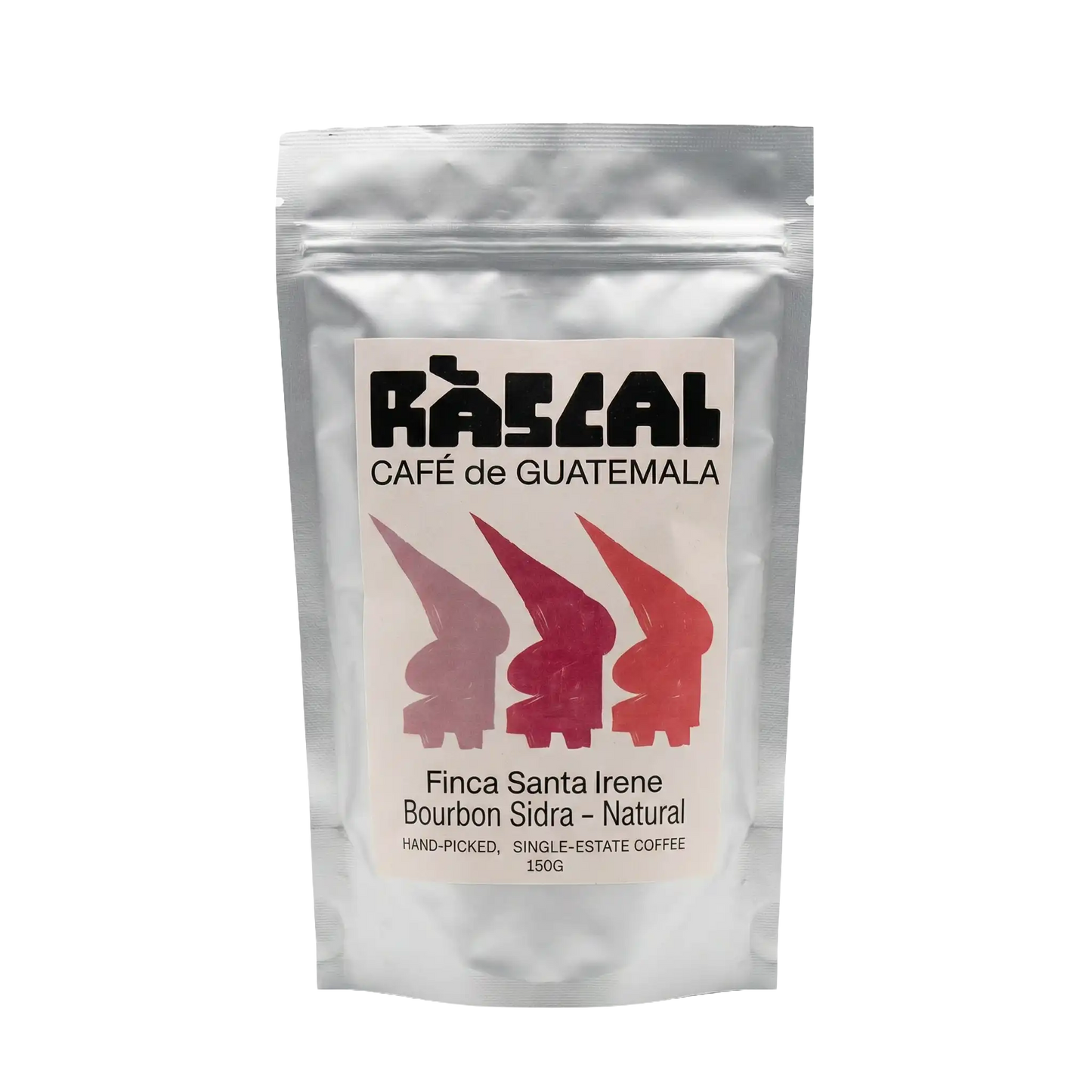
Finca Santa Irene - Bourbon Sidra - Natural
Finca Santa Irene - Bourbon Sidra - Natural
- Tasting notes of raspberry, grape, dark chocolate with malic acidity
- Bourbon Sidra is one of the rarest coffee varietals in the world
- Best enjoyed as filter, whole bean only
Farm Information
Farm Information
Saint Irene is a 129-hectare protected natural forest reserve owned by Dr. Jacinto Estrada Zanabria. In 2012, his son Carlos began cultivating 15 hectares within the reserve, planting Catuaí, Geisha, and Bourbon Cidra — a varietal originating from Ecuador — across the entire plot by 2013.
Catuaí is the farm's primary varietal, but Carlos's real passion lies in experimentation. He works with innovative processing methods, including a standout anaerobic, and recently invested in a glass greenhouse for drying — a testament to his commitment to quality and his willingness to challenge convention.
Processing
Processing
Natural
Prior to picking, cherry brix levels are measured to identify the ripest parcels. For the natural process, cherries are selected at peak ripeness, targeting the higher end of the brix range to ensure maximum fruit development during drying. Coffee is sorted at the end of the day, weighed, and transported directly to the drying area — bypassing the wet mill entirely.
Drying
Whole cherries are laid on raised beds with the skin and fruit intact, allowing the coffee to absorb the natural sugars and fruit characteristics of the cherry throughout the drying process. Given Cobán's famously humid climate, beds are carefully managed — monitored daily and turned regularly to ensure even drying and prevent over-fermentation or mould. Carlos's glass greenhouse plays a central role here, providing a controlled environment that protects the drying cherries from the chipi-chipi while maintaining airflow. Drying takes significantly longer than the washed process — typically several weeks — until the coffee reaches its ideal moisture content for storage, at which point the parchment is removed.
The result is a coffee that carries the full expression of the Bourbon Sidra cherry: intensely fruity, complex, and unlike anything produced through a washed process on the same farm
About the Region
About the Region
Cobán
The name Cobán comes from the Maya K'eqchi' word for "place of clouds" — and it earns that name every day of the year.
This region reminds us of England: constant rainfall, dense cloud cover, cool temperatures, and lush rolling hills that wouldn't look out of place in Ireland. Cobán has a climate entirely unlike any other Guatemalan growing region. Rather than the dry and rainy seasons found elsewhere, it experiences heavy rains from May to December — followed by the chipi-chipi. Known across Guatemala, this fine, persistent mist is Cobán's signature: not quite rain, not quite cloud, but something in between. It falls 9–10 months of the year, and annual rainfall reaches close to 4,000mm, making Cobán the wettest coffee-growing region in Guatemala.
Its proximity to the Atlantic Ocean drives this tropical, rainforest climate, and its soil — limestone and clay rather than volcanic — gives Cobán coffee a character that stands apart. The near-constant moisture means flowering is staggered across the year, producing 8–9 distinct flowerings rather than one defined harvest window. Most crops are shade grown and cultivated by small producers. Drying is the great challenge here: in a near-permanent mist, careful farm management is essential to prevent mould and to keep leaf rust at bay.
In the cup, Cobán delivers a good body, delicate acidity, and a fragrant aroma — a profile shaped entirely by the clouds it grows beneath.